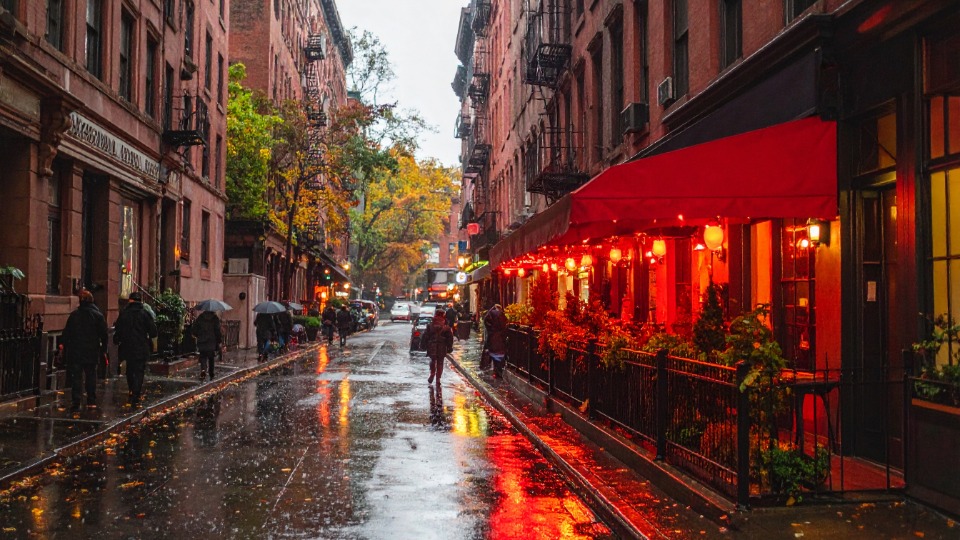
A Rainy Evening in the South Village
On a rainy evening in the South Village, the streets seem to compress time. The slick pavement along MacDougal Street reflects the glow of neon signs that have outlived trends, landlords, and entire eras of New York reinvention, casting warm reds and ambers onto umbrellas drifting past basement staircases. From below street level comes a memory that feels immediate: the muffled clink of silverware, the low hum of conversation, and the unmistakable aroma of garlic and simmering tomatoes cutting through the damp air. This is not the curated nostalgia of a pop-up or the self-conscious retro of a themed restaurant; it is something lived-in, accumulated, and quietly confident.
Places like Villa Mosconi, established in 1976, were already “old-school” before the term became fashionable again. While the rest of the city oscillated between nouvelle cuisine, molecular gastronomy, and minimalist tasting menus, these South Village dining rooms kept doing what they had always done. They served neighbors, artists, professors, and families who measured their lives in anniversaries marked by the same table. Today, as diners rediscover the appeal of white tablecloths and classic hospitality, the legacy of Villa Mosconi stands not as a revivalist but as a constant—a living archive of a New York that remains etched in the city’s collective memory.
The Best Italian Restaurants in Greenwich Village and the Return to Tradition
By 2026, it has become clear that New York diners are experiencing a collective course correction. After more than a decade of relentless novelty, hyper-regional menus, and fusion concepts that required footnotes, there is a renewed craving for reliability and emotional grounding. This movement, often dubbed the “Red Sauce Revival,” is actually a return to something deeper: trust. Diners want to know that the essence of a dish remains unchanged, layered with slow-cooked ragù and finished with the quiet authority of generational knowledge.

This shift speaks to a deeper desire for authenticity—not as a buzzword, but as an experience rooted in timeless hospitality. Restaurants that endured through the lean years did so because they understood something essential: trends come and go, but the human appetite for comfort, ritual, and recognition remains remarkably stable. In this context, the Mosconi name continues to be a focal point in conversations about the best Italian restaurants in Greenwich Village, not because it sought to reinvent the wheel, but because it honored the hands that turned it for decades.
Premium ingredients have also reentered the narrative, not as luxury signals but as quiet assurances of care. San Marzano tomatoes, high-quality olive oil, and properly aged Parmigiano Reggiano are no longer marketing points but expectations. For diners fatigued by constant culinary reinvention, the “old-school” establishment represents a form of refuge—a place where the pleasure lies in the continuity of flavor and the respect for the craft.
South Village Italian History: more than just a Location
Greenwich Village, and the South Village in particular, occupies a unique place in Manhattan’s Italian history. While Little Italy to the north became increasingly symbolic and touristic, the blocks around Thompson Street and MacDougal Street remained residential, woven into the daily rhythms of people who lived nearby. The proximity to Washington Square Park brought a constant flow of students, musicians, and thinkers, creating a cultural crosscurrent that shaped the neighborhood’s dining rooms into places of conversation as much as consumption.

Walking from the arch at Washington Square Park toward Thompson Street, one can feel the subtle transition between worlds. The grand openness of the park gives way to narrower streets, lower ceilings, and basement entrances that suggest intimacy rather than spectacle. Historic landmarks like Caffè Reggio, with its storied espresso machine dating back to the 1920s, anchor the area in a lineage that predates most modern dining trends. In this context, Villa Mosconi exists not in isolation but as part of an ecosystem that defined South Village Italian history for half a century.
Mentioning specific streets is not merely an exercise in nostalgia; it underscores how geography shapes experience. The Village’s density fostered deep relationships between restaurateurs and regulars, creating a culture in which hospitality was personal and legacy was built meal by meal. This sense of place is inseparable from the food itself, reinforcing why authentic NYC dining experiences cannot be replicated elsewhere—they are born from the very bricks and mortar of the South Village.
The Architecture of Hospitality in Authentic NYC Dining Experiences
To understand why old-school Italian dining resonates so deeply today, one must consider the physical architecture of hospitality. These were rooms designed for duration rather than turnover, where the weight of the silverware in your hand signaled permanence. White tablecloths absorbed sound, softening conversations into a collective murmur, while the warm amber lighting characteristic of South Village basements created a sense of shelter from the bustling city above. The absence of distracting music allowed voices to carry, reinforcing the idea that the dining room itself was an extension of the home.

The soundscape was as important as the visuals. There was the scrape of chairs pulled back for late arrivals, the practiced cadence of waiters calling orders, and the occasional burst of laughter from a table celebrating a milestone. These elements formed a choreography honed over decades, one that prioritized the diner’s comfort over the restaurant’s image. Unlike contemporary spaces engineered for social media, these historic dining rooms were meant to be inhabited and felt, not merely documented.
Central to this architecture is the figure of the “old-school” waiter, a profession that reached its peak in the dedicated service of the Mosconi family. These professionals remembered preferences, guided guests through the menu without condescension, and understood the rhythm of a meal intuitively. Their authority was quiet, built on years of repetition, reinforcing the sense that you were not simply being served but welcomed into a continuity that transcends the present moment.
What Makes a Dining Experience Truly Old-School
The distinction between old-school and merely old-fashioned lies in intention. A truly old-school dining experience begins with the welcome, where guests are treated as participants in a shared history. At the table, simplicity reigns. White tablecloths and fresh bread brought without ceremony signal that the focus is on the human connection and the integrity of the plate.
The menu serves as a common language, offering dishes that are embedded in cultural memory. Mastering classic dishes like the traditional Veal Milanese—where the texture of the breading and the quality of the meat speak for themselves—requires a level of technical discipline that modern “fusion” often lacks. Lasagna, Ossobuco, and house-made pasta appear not as throwbacks, but as standards of excellence that have stood the test of time.
Finally, there is the pacing of the meal, which resists the urgency of modern commerce. Courses arrive when they are ready, allowing the evening to unfold organically. This approach is exactly why so many travelers and locals alike seek out authentic NYC dining experiences; they are looking for a respite from a world that too often prioritizes speed over substance and efficiency over elegance.
A Legacy in Transition and the Spirit of the Village
No discussion of South Village Italian dining would be complete without acknowledging the nature of change. Over the years, many legendary spots have entered a period of transition, responding to the evolving landscape of Manhattan. Yet the spirit of the Village has proven remarkably resilient, passing from one generation to another like a torch rather than a relic.
While physical doors may close or management may evolve, the “Spirit of the Mosconi Legacy” lives on in the recipes, the standards of service, and the intangible feeling of what a neighborhood institution should be. These are forms of cultural capital that transcend a single name or a specific year. The legacy of Villa Mosconi (est. 1976) remains a blueprint for the future of New York hospitality—a reminder that authenticity is the only trend that never fades.
Conclusion: Carrying the Torch
As the world continues to change at an accelerating pace, Greenwich Village offers a reminder that some experiences are worth preserving in their original spirit. Celebrating an old-school Italian legacy is not an act of looking backward, but an acknowledgment that the city’s cultural fabric is woven from places that chose consistency over reinvention. On a rainy evening, when the lights glow warmly beneath street level and the scent of a slow-simmered sauce fills the air, the South Village reveals itself once again.
For those who cherish the history of New York, the reward is more than just a memory of a meal; it is a connection to a living history. In the steady rhythm of service and the familiar comfort of Northern Italian classics done right, we find the soul of authentic NYC dining. As we look toward the future, the lessons of the past—of family, of quality, and of the MacDougal Street glow—remain our most reliable guide.