The Timeless Allure of the Village
In a city defined by perpetual reinvention, Greenwich Village endures as an anomaly. While much of Manhattan has been reshaped by glass towers, luxury developments, and global uniformity, the Village has preserved something far less tangible and far more valuable: its soul. Walking its streets feels less like navigating a metropolis and more like entering a lived-in manuscript, where history is not sealed behind plaques but embedded in everyday life. Corners curve unexpectedly, buildings bear the marks of age without apology, and the rhythm of the neighborhood resists the urgency that defines so much of contemporary New York.
This persistence is not accidental. The Village’s charm lies in its refusal to surrender to efficiency alone. It remains a place where memory accumulates rather than disappears, where the past coexists comfortably with the present. In doing so, it continues to define what an Authentic Manhattan neighborhood can look like in the twenty-first century.

A Legacy of Rebellion and Art
Greenwich Village history is inseparable from its reputation as a haven for dissent and creativity. In the early and mid-twentieth century, the neighborhood became a crucible for artistic movements that challenged cultural norms and redefined American identity. Along MacDougal Street, literary cafés and smoky basements hosted writers, poets, and musicians who found freedom in the Village’s tolerance and density. The street functioned as both stage and refuge, a place where ideas circulated as freely as coffee and cigarettes.
The legacy of the Beat Generation still lingers in the area’s ethos, even if the original protagonists have faded into history. Later, figures such as Bob Dylan would arrive, drawn by the same promise of artistic autonomy. What remains today is not nostalgia for rebellion, but an atmosphere shaped by it. The Village still feels permissive, open to experimentation, and resistant to homogenization, qualities that continue to attract those seeking a neighborhood with intellectual and cultural texture.
The Architecture of Intimacy
One of the most profound reasons the Village feels different lies in its physical form. Unlike most of Manhattan, Greenwich Village largely escaped the rigid grid imposed by the Commissioners’ Plan of 1811. Its streets follow older paths, resulting in an urban fabric that favors wandering over straight lines. This irregularity fosters intimacy, encouraging chance encounters and slow discovery rather than hurried transit.
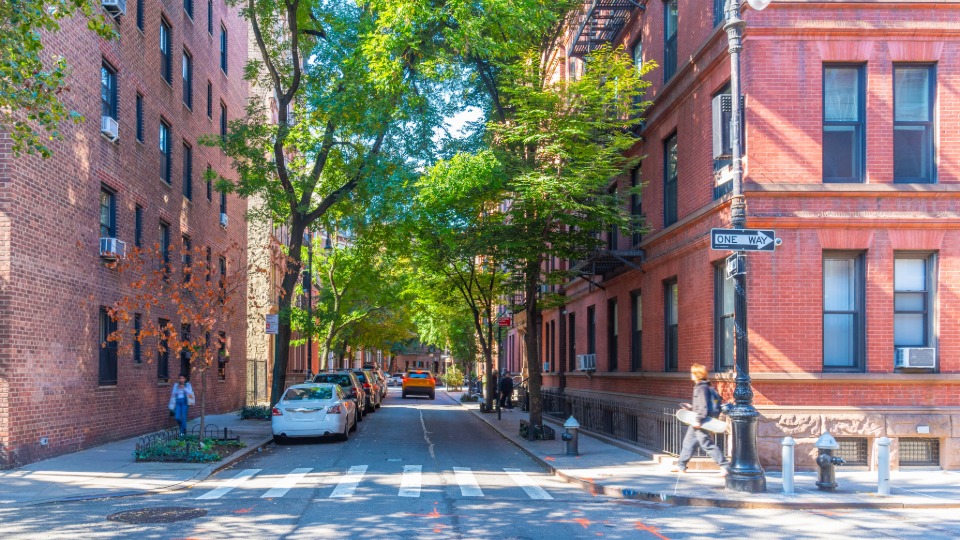
Brownstones and low-rise buildings dominate the landscape, reinforcing a human scale that is increasingly rare in New York. Stoops become social spaces, façades tell stories of adaptation rather than replacement, and neighborhoods feel inhabited rather than optimized. This architectural character does more than please the eye; it shapes behavior, creating conditions for community that cannot be engineered overnight. Among Historic NYC neighborhoods, the Village stands out for having preserved not just buildings, but the social life those buildings make possible.

The Italian Heart of the South Village
Within Greenwich Village, the South Village holds a distinct identity rooted in Italian immigration. In the late nineteenth and early twentieth centuries, Italian families settled in this area, imprinting it with customs, language, and a culinary sensibility that endures to this day. Walking through the South Village, one notices architectural details that hint at this past: ornate cornices, modest tenements, and ground-floor storefronts that once served as anchors of daily life.
The sensory experience remains powerful. Aromas of coffee, bread, and slow-cooked sauces seem to linger in the air, especially along streets that have resisted total commercial transformation. This is the essence of South Village Italian heritage, not preserved as a museum exhibit but lived through continuity. While other parts of the city have seen their ethnic identities diluted or displaced, the South Village retains a distinctly European rhythm, offering one of the last glimpses of an older New York shaped by immigrant communities.
Preserving the Human Scale
In an era dominated by vertical ambition and digital abstraction, Greenwich Village represents a necessary counterbalance. Its streets encourage walking rather than rushing, conversation rather than isolation. The absence of towering skyscrapers allows light to reach the sidewalks, reinforcing a sense of openness despite density. This human scale fosters warmth, a feeling that the city is not something to be endured but engaged with.
For residents, this scale translates into daily rituals that feel personal rather than anonymous. For visitors, it offers a reminder that New York’s greatness has always depended on neighborhoods that prioritize people over spectacle. In this sense, Greenwich Village’s preservation is not a rejection of progress but a redefinition of luxury. The ability to slow down, to recognize familiar faces, and to inhabit history rather than consume it has become increasingly rare—and increasingly valuable.

An Invitation to Get Lost
To truly understand why Greenwich Village remains Manhattan’s most authentic neighborhood, one must experience it without an agenda. Wander without direction, follow the curve of a street simply because it invites you, pause where the city seems to whisper rather than shout. The Village reveals itself gradually, rewarding those who take the time to listen.
In a metropolis that often celebrates the new at the expense of the enduring, Greenwich Village stands as proof that authenticity is not about resisting change entirely, but about integrating it thoughtfully. Its streets, stories, and communities continue to offer a version of New York that feels rooted, human, and alive. For anyone seeking the essence of the city, there is still no better place to begin than here.