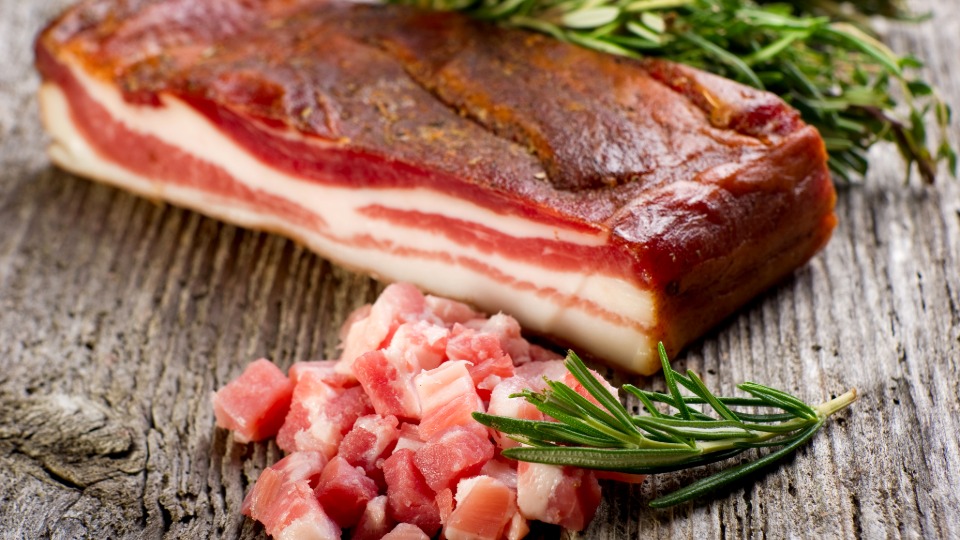
In much of the world, the word bacon has become a culinary catchall, used to describe nearly any form of cured pork. In Italy, such simplification would be unthinkable. The distinction between Pancetta vs Guanciale is not merely technical; it is cultural, historical, and deeply tied to regional identity. These are not interchangeable products but two expressions of the ancient art of Italian pork curing, each with its own anatomy, flavor profile, and rightful place in the kitchen.
As both a norcino—a specialist in traditional Italian salumi—and a Roman chef, I can say with certainty that understanding the difference between these two cuts is essential to grasping the soul of Italian cuisine. The cut of the animal, the curing method, the fat structure, and the way heat transforms that fat all influence the final dish. Nowhere is this more evident than in the canonical Roman pastas, where the wrong choice can subtly but decisively alter the outcome.
What Is Pancetta? (The Belly)

Pancetta comes from the belly of the pig, the same anatomical area used to produce American bacon. However, unlike most bacon in the United States, traditional pancetta is not typically smoked (unless strictly specified as pancetta affumicata). Instead, it is cured with salt and spices, then aged to develop depth and complexity.
There are two principal styles: pancetta arrotolata (rolled) and pancetta tesa (flat). Rolled pancetta is seasoned, tightly coiled into a cylinder, and aged, resulting in the characteristic spiral pattern when sliced. Flat pancetta is cured and aged without rolling, making it easier to cube or slice into lardons for cooking. Both styles are foundational examples of authentic Italian salumi, widely used across central and northern Italy, particularly in Emilia-Romagna.
Flavor-wise, pancetta tends to be aromatic and gently spiced, often seasoned with black pepper, garlic, nutmeg, or rosemary. Its taste is savory yet rounded, with a balance between lean meat and fat. When rendered, pancetta releases flavor pleasantly, but its fat structure is softer and less concentrated than that of guanciale. It provides richness and aroma, but in certain dishes, it lacks the intensity and emulsifying power required for true Roman authenticity.
What Is Guanciale? (The Cheek)

Guanciale is made from the pork jowl or cheek (guancia), a smaller and more specialized cut that yields one of the most prized fats in the Italian culinary tradition. The cheek contains a higher concentration of dense, silky fat interwoven with muscle, creating a texture and flavor that are unmistakably distinct from the belly.
After trimming, the guanciale is cured with salt and typically seasoned generously with black pepper, and sometimes a hint of chili or local herbs. It is then air-dried and aged for at least three months. A crucial detail for the home cook is the cotica (the thick skin). Unlike pancetta, guanciale is cured with its skin on to protect the meat during aging; this hard rind must be sliced away before cooking, though the peppery crust on the meat itself should remain to flavor the pan.
When cooked, guanciale behaves differently from pancetta. Its fat melts gradually and evenly, transforming into a glossy, luxurious base that coats ingredients rather than simply lubricating them. The rendered fat carries concentrated pork flavor—a funky, savory depth—while maintaining a velvety texture. This unique profile is protected by institutions like the Consorzio del Guanciale Amatriciano, which ensures that the production methods remain true to history. This is why guanciale holds a privileged position in our kitchen: it is not just an ingredient, but a piece of heritage.
The Great Debate: Carbonara & Amatriciana
The debate over Pancetta vs Guanciale reaches its most passionate expression in discussions about Carbonara and Amatriciana. In Rome, there is no ambiguity: guanciale is the only acceptable choice for these iconic dishes.
In Carbonara, guanciale is gently rendered until its exterior becomes lightly crisp while the interior remains tender. The rendered fat then forms the essential foundation for the sauce. When combined with egg yolks and Pecorino Romano, it creates a natural emulsion—silky, cohesive, and deeply savory. This transformation happens because guanciale’s fat composition (harder and more noble than belly fat) allows it to bind seamlessly with the proteins in the egg and cheese. Pancetta, by contrast, releases a lighter, more liquid fat that does not emulsify with the same stability, often resulting in a sauce that lacks depth or separates on the plate.
In Amatriciana, the principle is similar. The guanciale is sautéed until golden, releasing its aromatic fat into the pan. That fat then carries the flavor of the tomatoes and Pecorino, creating a sauce that is at once sharp, sweet, and richly pork-forward. Substituting pancetta may produce a pleasant pasta, but it will not achieve the structural harmony that defines authentic Roman execution. For purists and professionals alike, guanciale is not a suggestion; it is a requirement.
When to Use Which: A Practical Guide
Understanding when to use pancetta and when to use guanciale is essential for anyone interested in authentic Italian cooking at home.
Choose Pancetta for:
- Soffritti: It provides a gentle savory base for soups, ragù, and stews.
- Vegetable Dishes: It pairs beautifully with beans, lentils, and braised greens where you want pork flavor without overpowering the vegetables.
- Fillings: In Emilia-Romagna, it is often minced into fillings for tortellini or layered into rustic breads.
Choose Guanciale for:
- The Roman Quartet: Carbonara, Amatriciana, Gricia, and classic Cacio e Pepe variations.
- Texture: Use it when you need the contrast between a crispy exterior and a melting fondant center.
- Fat-Based Sauces: If the dish relies on the rendered fat itself to build the sauce (emulsion), guanciale is mandatory.
A practical rule of thumb is simple: if the pork is the star of the show, choose guanciale. If the pork is a supporting player contributing background aroma, pancetta is the correct choice.
A Final Invitation to Authenticity
To truly appreciate the debate over Pancetta vs Guanciale is to understand that Italian cuisine is built on specificity. Each ingredient carries a geographic and cultural identity that shapes the final plate. The art lies not in substitution but in alignment—matching the correct cut to the correct preparation.
At Villa Mosconi, this philosophy remains central. Whether drawing from Roman tradition or the refined discipline of Emilia-Romagna, the choice of salumi reflects a commitment to authenticity rather than convenience. In a world where “bacon” is often used as shorthand, rediscovering the nuanced beauty of these Italian cured meats offers a deeper connection to the culinary heritage of Italy—and to the standards that define true Italian cooking.