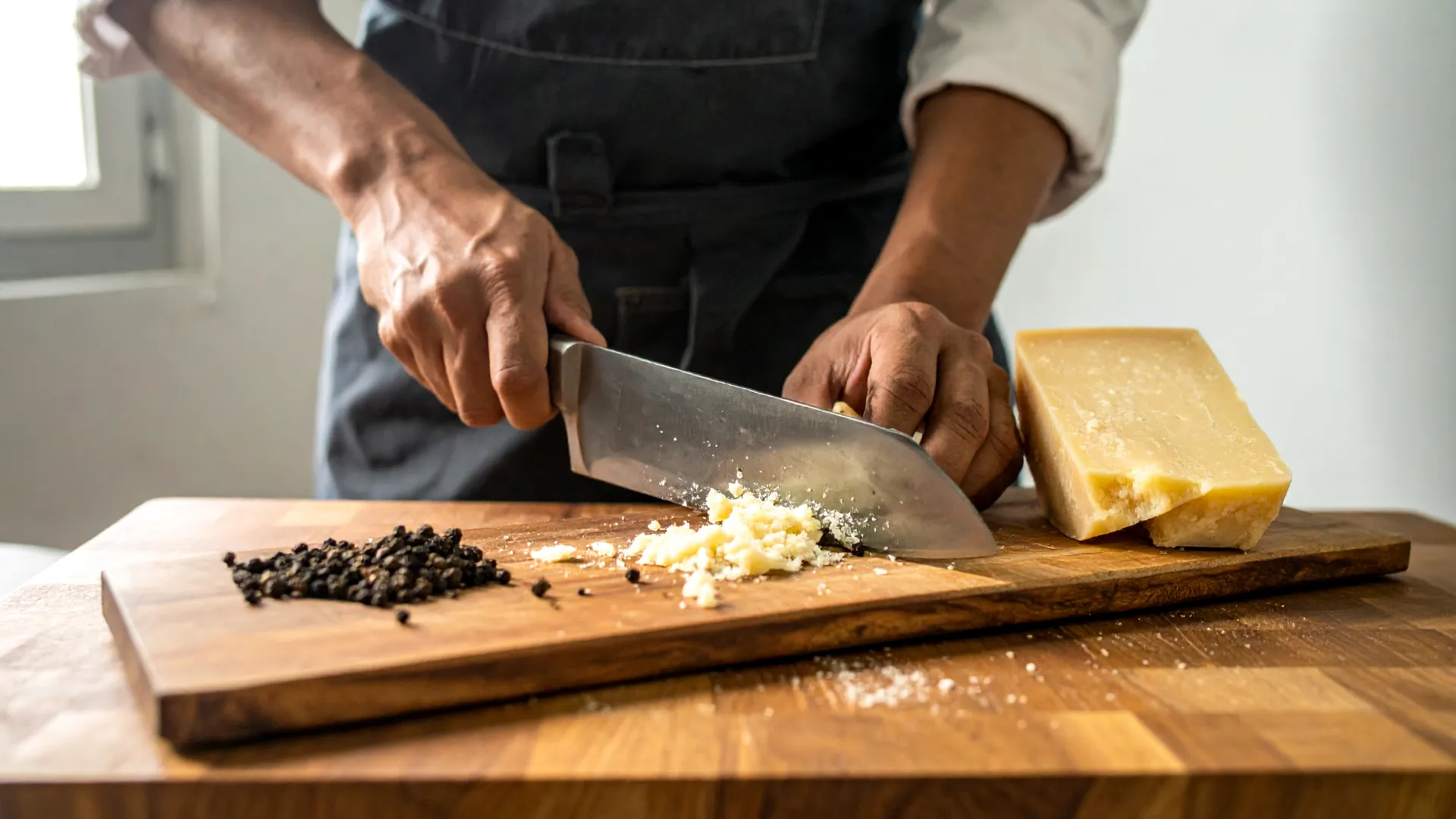

The sharp, aggressive scent of freshly cracked black peppercorns singing against a dry, searing skillet instantly commands the kitchen. There is no chorus of aromatic vegetables softly sweating in olive oil, no rich stock simmering on a back burner. Instead, there is only the elemental hiss of water meeting fire, and the powerful, unmistakable tang of aged sheep’s milk cheese waiting its turn.
To approach Cacio e Pepe is to strip away every culinary safety net. It is a dish that hides absolutely nothing, relying entirely on the profound mastery of technique rather than a prolonged grocery list. Within its sparse framework, the true soul of Roman gastronomy is revealed—a testament to the fact that absolute perfection is often born of absolute necessity.
What Defines an Authentic Cacio e Pepe Recipe?
For those devoted to true minimalist cooking, understanding the strict unwritten laws of this ancient Roman preparation is non-negotiable. A flawless Cacio e pepe recipe rests upon an unyielding foundation:
- Pecorino Romano DOP: The only acceptable cheese. Its high salt content and specific protein structure from sheep’s milk are fundamentally required for the emulsion.
- Whole Black Peppercorns: Pre-ground dust is a culinary offense. The pepper must be freshly cracked and toasted in a dry pan to awaken its dormant, volatile oils.
- Starchy Pasta Water: The invisible binding agent. The cloudy, white water extracted precisely at the pasta’s al dente stage is what bridges the gap between fat and liquid.
- Thermal Discipline (Off-Heat Emulsion): Applying direct heat to the cheese will instantly coagulate the proteins, turning a silky sauce into a separated, stringy disaster.
The Shepherds’ Sustenance: A Roman Legacy
The lineage of this iconic dish traces back not to the velvet-draped dining rooms of the aristocracy, but to the rugged, sun-baked pastures of the Apennine Mountains. During the seasonal migrations, Roman shepherds required sustenance that was virtually imperishable. They carried dried pasta, hardened wedges of salted cheese, and sacks of fiery spice.
These ingredients could withstand weeks of travel under the harsh Italian sun. At nightfall, using nothing but a portable iron pot and water drawn from a local stream, the shepherds would conjure a meal of profound caloric density and shocking flavor. The history of Pecorino Romano itself is inextricably tied to these pastoral journeyings, predating even the formal establishment of the Roman Empire.
Today, executing this dish honors those ancient, windswept nights. Every time the heavy cheese is grated into a waiting bowl, we participate in a ritual of survival that has gracefully evolved into a pinnacle of modern fine dining. It is a stunning paradox: the ultimate peasant food is now the ultimate test of a chef’s finesse.
The Philosophy of Minimalist Cooking
In our contemporary era of over-engineered menus and frantic culinary fusion, the restraint required for Cacio e pepe feels almost radical. It demands that you place total faith in the quality of your raw materials. There is no heavy cream to stabilize the sauce, nor butter to artificially gloss the noodles.
When exploring the vast catalog of traditional Italian recipes, one quickly realizes that the peninsula’s culinary philosophy is remarkably consistent: elevate a few exceptional ingredients to their highest possible expression. The technique is the ingredient. This requires patience, a watchful eye, and an intuitive understanding of how starches and fats behave under varying degrees of thermal pressure.
The unforgiving nature of the emulsion
The battleground for this dish is the pan, and the weapon of choice is the starchy pasta water. As the pasta boils, it sheds its exterior layer of starch into the surrounding liquid. This cloudy water is the literal glue that will eventually force the sharp fat of the Pecorino Romano to bond with the spicy water of the toasted pepper.
Mastering this delicate starch balance is a theme echoed across the grand canon of Italian cooking—much like understanding the precise moisture levels required to craft fluffy potato gnocchi without structural failure. Too much water, and the sauce breaks into a watery soup. Too little, and it clumps into heavy, unappetizing cement.
While Parmigiano-Reggiano may often be globally heralded as the king of cheese, in the Roman pantheon, the aged sheep’s milk reigns supreme. Its aggressive salinity and sharp tang are the only forces robust enough to stand toe-to-toe with the assertive heat of the pepper.

The Alchemist’s Guide: Orchestrating the Mantecatura
We arrive at the crescendo. To begin this Cacio e pepe recipe, you must first crush whole black peppercorns under the blade of a heavy knife. Scatter the coarse shards into a wide, cold skillet and turn the flame to medium. Within moments, a pungent, floral smoke will rise. Deglaze this aggressive heat with exactly two ladles of boiling pasta water. The resulting liquid will bubble furiously, turning an opaque, golden-grey.
Meanwhile, heavily salt a pot of boiling water and submerge your pasta—traditionally a thick, porous Tonnarelli or a rough, bronze-die Spaghettoni. You must extract the pasta a full three minutes before it reaches its al dente climax. Transfer the dripping noodles directly into the bubbling, pepper-infused water. They will finish cooking here, absorbing the spicy liquid directly to their core.
In a separate, cool bowl, prepare the pastella. Mound two generous cups of finely grated, snow-like Pecorino Romano. Add a splash of tepid (never boiling) water, stirring vigorously with a whisk until a thick, spackling paste forms. This pre-emulsion is the chef’s ultimate safeguard against stringy cheese.
Now, execute the final alchemy. Remove the skillet of pasta entirely from the heat. The frantic boiling must cease. Introduce the heavy cheese paste into the center of the pan. Over the residual heat, begin the mantecatura—a violent, rhythmic tossing and stirring. As you agitate the pan, the starchy liquid and the melting cheese collide.
Right before your eyes, the disparate elements will miraculously bind, blooming into a cascading, velvety cream that coats every individual strand in a glossy, suspended embrace.
The Timeless Magic of the Roman Table
To twirl a perfectly executed forkful of this dish is to experience the raw, unpolished brilliance of true Italian gastronomy. The immediate, sharp salinity of the cheese initiates the palate, closely followed by the lingering, aromatic fire of the toasted pepper. The texture is impossibly rich, yet achieved without a single drop of added fat.
It stands as a beautiful, edible reminder that true mastery does not require complexity. In the quiet alchemy of boiling water, aged milk, and cracked spice, we find an immortal tradition that refuses to be improved upon. It is the eternal, rustic poetry of the Roman countryside, plated with dignity and served with absolute, uncompromising pride.