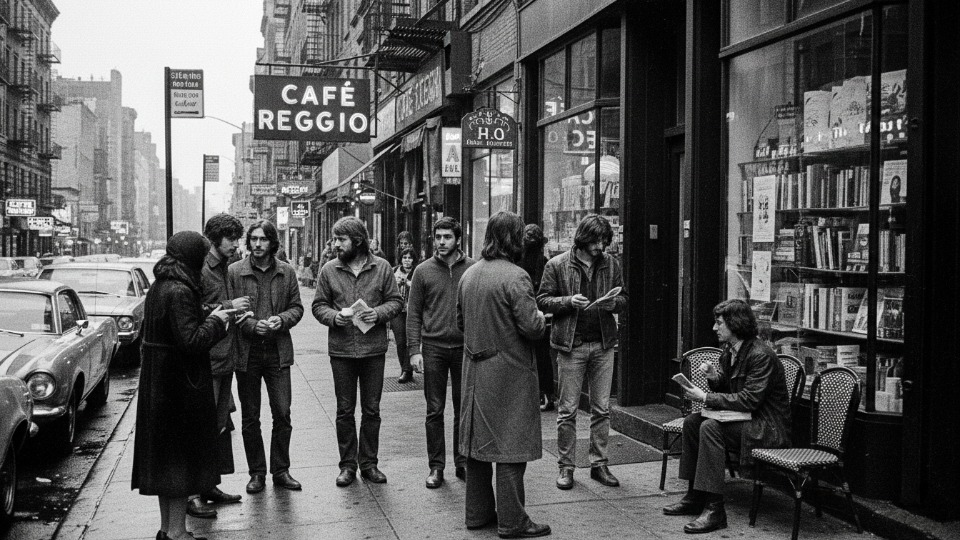
The Setting: An Old New York Atmosphere in Flux
In the mid-to-late 1970s, Greenwich Village existed in a state of productive tension. New York City was financially strained, culturally restless, and profoundly alive, and nowhere was this more evident than along MacDougal Street. The air carried overlapping scents: roasted coffee drifting from historic cafés, cigarette smoke clinging to wool coats, and the unmistakable perfume of garlic and slow-cooked sauces rising from basement kitchens. Jazz spilled out of narrow doorways, folk music echoed faintly from upstairs apartments, and the sidewalks functioned as informal salons where arguments about politics, poetry, and pasta unfolded with equal intensity.
This was a neighborhood shaped by its Italian roots, even as the children and grandchildren of immigrants shared space with artists, academics, and the lingering shadows of the Beat Generation. The Old New York atmosphere was not romanticized at the time; it was lived, negotiated daily through noise, grit, and extraordinary creativity. It was becoming a place of settlement, where families built routines and restaurants matured into institutions.
Shadows of Bohemia: A Chapter in MacDougal Street History
MacDougal Street history has always resisted simple definitions. In the 1950s and 60s, it was synonymous with counterculture, its cafés and clubs hosting writers, musicians, and thinkers who challenged American norms. By the 1970s, that energy had not vanished, but it had evolved. The street became a crossroads where longtime residents, NYU students, working-class Italian families, and cultural transplants intersected, often over meals that lasted longer than planned.
This was the era when dining in the Village stopped being purely incidental and became intentional. Restaurants were no longer just places to refuel between readings or rehearsals; they were destinations in their own right, shaping social life as much as reflecting it. Along MacDougal and the nearby stretch toward Thompson Street, the dining room emerged as a democratic space. In this environment, food functioned as a common language, grounding the street’s intellectual and artistic ambitions in something tangible.
From Bohemia to the Table: Greenwich Village 1970s Dining
The scene defining Greenwich Village 1970s dining was characterized less by trend than by transition. As the fervor of the Beat Generation softened, a new seriousness entered the kitchen. Italian-American restaurateurs, many drawing from regional traditions rather than generic red sauce formulas, began asserting a culinary manifesto rooted in discipline and memory. This shift marked a quiet but consequential evolution, one that elevated dining without abandoning warmth.

Restaurants became places where ideas were tested as rigorously as recipes. The food was generous, but it was also deliberate, reflecting a belief that craft mattered. The Village’s diners, accustomed to experimentation in art and thought, responded to this seriousness with loyalty. They recognized that something enduring was taking shape, a form of excellence that did not announce itself loudly but revealed itself through consistency.
The 1976 Milestone: Emilian Discipline and the Birth of a Classic
When Villa Mosconi opened in 1976, it did so at precisely the right moment. The city was changing rapidly, but the neighborhood still valued continuity, and the Mosconi family offered it in the form of Emilian sensibility. Drawing from the culinary traditions of Emilia-Romagna, the restaurant introduced a standard of rigor that felt both reassuring and quietly radical. This was not Italian food as spectacle; it was Italian cooking as structure, balance, and respect for process.
Villa Mosconi quickly established itself as a linchpin of South Village dining, not by chasing attention but by earning trust. Its presence on MacDougal Street signaled that the local culture was maturing, capable of honoring its bohemian past while embracing a more refined future. For locals, the restaurant became a constant, a place where the rhythms of daily life could unfold against a backdrop of reliable excellence.
The Social Architecture of South Village Dining
In the 1970s, restaurants were understood as neighborhood institutions rather than mere businesses. They served as informal meeting halls, places where birthdays were celebrated, arguments resolved, and relationships maintained. The Italian dining room, in this context, was a social architecture designed for connection. Tables were close, conversations overlapped, and the line between staff and regulars blurred over time.
This philosophy reflected a broader Italian-American understanding of hospitality as responsibility. To open a restaurant was to commit to a community, to show up night after night with the same standards and the same care. In the South Village, where change was constant and uncertainty a given, these dining rooms offered stability. They anchored the street emotionally, providing a sense of belonging that extended beyond the plate.
Continuity Amid Change: Preserving the Villa Mosconi Legacy
As the 1970s gave way to the 1980s, Greenwich Village continued to evolve. Rents rose, demographics shifted, and the city began its long transformation into a global capital of culture and commerce. Yet the soul of MacDougal Street endured, preserved in places that resisted reinvention for its own sake. The Villa Mosconi legacy is built on the refusal to compromise; its commitment to Emilian discipline and neighborhood values allowed it to navigate these changes without losing its identity.
This continuity was not accidental. It was the result of choices made daily, in the kitchen and the dining room, reinforcing a standard set decades earlier. The restaurant’s history became intertwined with the street’s own narrative, each reinforcing the other in a quiet dialogue between past and present.
The Living Memory of MacDougal Street
Today, when diners speak of Villa Mosconi, they are often responding to something they can feel but not immediately articulate. It is the sensation of stepping into a room where time has been layered rather than erased, where the standards of the 1970s still inform the experience without feeling frozen. The Old New York atmosphere survives here not as nostalgia but as practice, sustained through attention to detail and respect for lineage.
MacDougal Street no longer looks exactly as it did in the 1970s, but its spirit persists in places that understand their role as custodians of memory. Villa Mosconi remains one such place, a reminder that great dining is not defined solely by innovation but by continuity. In honoring the golden age of Greenwich Village dining, it continues to demonstrate that the values forged in that era still matter, shaping experiences that feel as meaningful now as they did nearly fifty years ago.