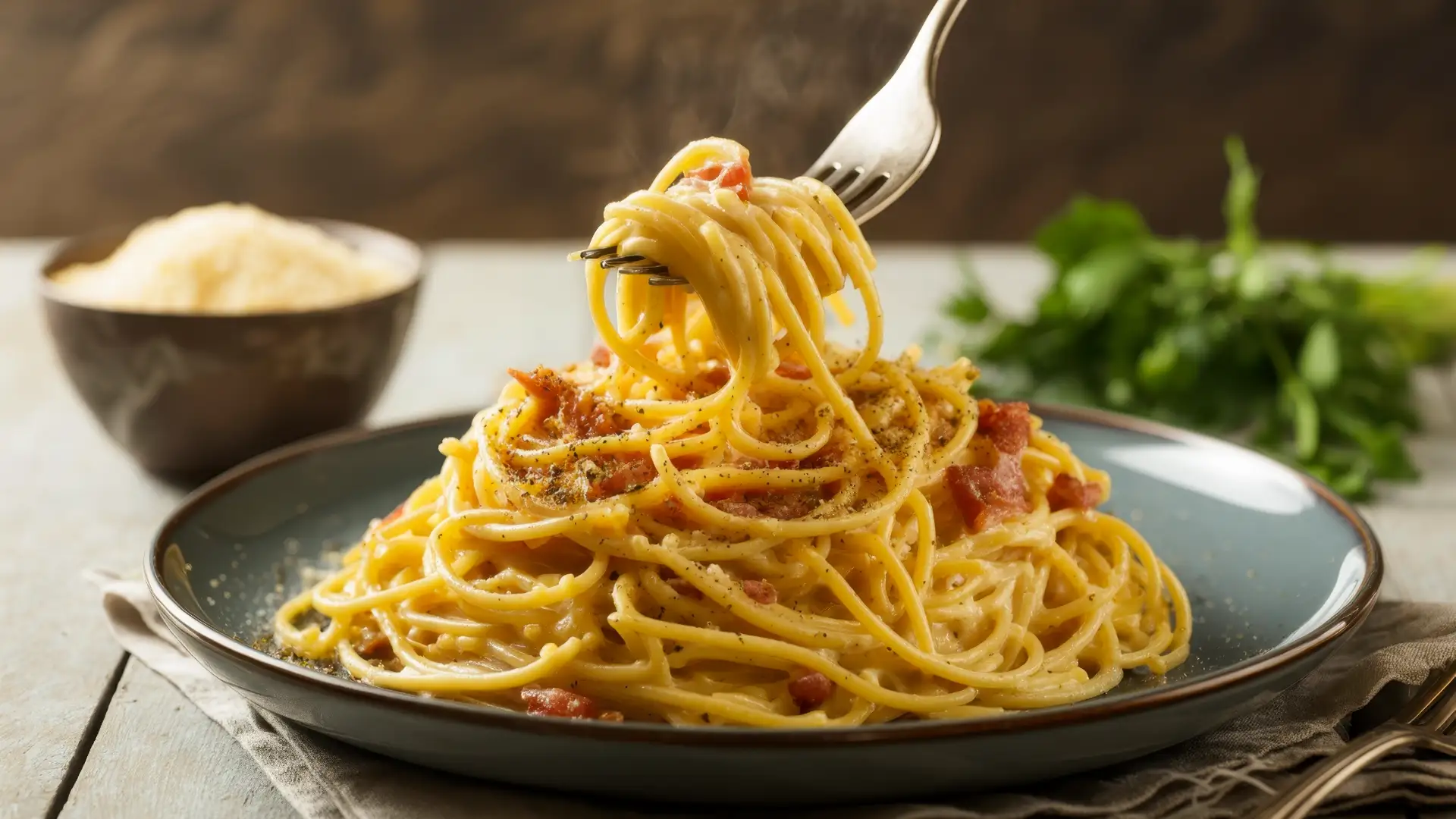
The sharp, unmistakable crackle of cured pork fat hitting a hot skillet shatters the quiet of the kitchen. Almost instantly, an intoxicating perfume fills the air—a rugged, savory blend of toasted black pepper and melting, glistening lard. There is no garlic, no onion, and certainly no heavy cream to mute this primal symphony. This is the scent of pure, unadulterated Roman history simmering over an open flame.
To understand the authentic Roman Carbonara is to embrace the profound elegance of Italian minimalism. It is a dish that relies not on a multitude of complex components, but on the flawless execution of a few sacred ingredients. In the modern culinary landscape, this ancient preparation has often been misunderstood, diluted by shortcuts and unnecessary additions. Yet, when stripped back to its fundamental essence, it reveals an alchemical perfection that no modern shortcut can ever replicate.
Mastering this discipline requires unlearning decades of commercialized habits. It demands a return to the absolute basics of heat manipulation, starch extraction, and emulsion. To dine on true Carbonara is to taste the austere beauty of the Apennine Mountains and the bustling, timeless energy of the Roman trattorie.

The Myth and the Mountain Origins
The exact origins of this legendary pasta remain veiled in a blend of culinary folklore and post-war history. Some romanticize it as the hearty sustenance of the carbonari, the charcoal burners who worked in the densely wooded mountains of central Italy. They would carry robust, non-perishable provisions: dry pasta, hard mountain cheese, and cured pork. The heavy dusting of black pepper, according to the legend, mirrored the coal dust that permanently stained their hands.
Others point to a more modern genesis, tracing the dish to the immediate aftermath of World War II. As American GIs liberated Rome, their daily military rations included powdered eggs and bacon. Local cooks, possessing an inherent genius for transforming humble ingredients into masterpieces, allegedly combined these rations with local cheese and pasta to create the modern iteration we recognize today. Historical accounts of Carbonara often debate these timelines, but the core philosophy remains undisputed: it is a dish born of necessity, elevated by technique.
Regardless of its true inception, one fact stands absolute in the annals of Italian gastronomy: heavy cream has absolutely no place in the recipe. The addition of cream is an international shortcut, a culinary heresy designed to mask poor technique and artificially stabilize an emulsion that should be achieved solely through the natural bonding of starches and fats.
The Holy Trinity of Roman Flavor
The soul of an authentic Roman Carbonara rests entirely upon three non-negotiable pillars. To compromise on any of these is to create an entirely different dish. The first, and arguably the most crucial, is Guanciale. Unlike pancetta or standard bacon, guanciale is the cured jowl or cheek of the pig. It boasts a profoundly rich, buttery texture and a distinctively sweet, slightly herbaceous flavor profile due to its traditional curing process. Procuring an authentic cured guanciale is the first mandatory step for anyone seeking true Roman flavor.
The second pillar is the cheese. While some modern interpretations allow for a blend of cheeses, the uncompromising purist reaches exclusively for Pecorino Romano. This ancient, hard cheese, crafted from sheep’s milk, delivers an aggressive, salty bite that cuts perfectly through the richness of the pork fat and egg yolks. Its crystalline texture and sharp tang are so vital to the region’s culinary identity that it holds a fiercely protected status, as detailed by the Pecorino Romano PDO consortium standards.
Finally, there is the black pepper. It cannot be pre-ground dust sitting stale in a pantry. It must be whole black peppercorns, fiercely toasted in the dry pan before being cracked, releasing their volatile oils and providing a fragrant, spicy backbone that balances the intense richness of the dish.

The Geometry and Starch of the Pasta
The vehicle for this magnificent sauce requires careful consideration. While the long, elegant strands of Spaghetti are internationally synonymous with the dish, Roman purists often favor short, tubular shapes like Rigatoni or Mezze Maniche. These shapes offer a substantial bite and feature ridges (rigate) that grip the glossy sauce, while their hollow centers act as perfect reservoirs for the rendered pork fat and cheese.
Whatever shape you choose, the quality of the pasta is paramount. The extrusion method directly impacts the success of your final emulsion. A high-quality, bronze-die extruded spaghetti possesses a rough, porous surface. As it boils, it releases a significant amount of starch into the cooking water. This cloudy, starchy liquid is the secret binding agent that will eventually marry the fat and the egg yolks together.
The pasta must be cooked strictly al dente, pulled from the boiling water a full two minutes before the package instructions suggest. It will finish its journey in the pan, absorbing the foundational flavors of the guanciale and pepper.
The Alchemy of the Emulsion: Mastering the Technique
The creation of the perfect Carbonara emulsion is a breathtaking display of culinary science. It is a tightrope walk between a luxuriously silky sauce and a tragic pan of scrambled eggs.
Begin by slicing the guanciale into thick, substantial batons. Place them into a cold carbon steel skillet, turning the heat to medium-low. As the pan gradually warms, the guanciale will begin to weep, slowly rendering its translucent liquid gold while the exterior turns irresistibly crisp. Once browned, remove the crispy pork from the pan, leaving the shimmering fat behind. Crack a generous amount of fresh black pepper directly into the hot fat to toast for thirty seconds.
In a separate bowl, prepare the golden paste. For every pound of pasta, whisk together four large egg yolks and one whole egg. Using a fine Microplane grater, shower in a mountain of finely grated Pecorino Romano—at least two tightly packed cups. Whisk vigorously until you have a thick, golden, almost paste-like consistency.
Here is where the magic happens. Transfer the al dente pasta directly into the skillet with the peppered fat. Toss vigorously over low heat to coat every strand. Then, perform the most critical step: remove the skillet entirely from the heat.
Introduce a ladle of the starchy, slightly cooled pasta water to your egg and cheese paste to temper it, then pour the mixture over the pasta. Toss frantically. The residual heat of the pan and the pasta will gently cook the egg yolks, while the starch from the water emulsifies the melted Pecorino and pork fat. Within seconds, a glossy, velvety, miraculously thick cream will form. Fold the crispy guanciale back into the silken tangle.
The Heresy of the Heavy Cream Shortcut
Why does the world so often reach for a carton of heavy cream? Because mastering the mantecatura—the vigorous off-heat tossing—requires patience, nerve, and practice. Cream is an insulator; it prevents eggs from coagulating too quickly, effectively dummy-proofing the recipe.
However, this shortcut exacts a heavy toll. Cream dilutes the sharp, salty punch of the Pecorino. It muddles the delicate, sweet pork flavor of the guanciale. Most tragically, it weighs the dish down, transforming a glossy, vibrant masterpiece into a heavy, cloying swamp.
The true creaminess of Carbonara is an illusion. It is a fleeting, magical state of suspended animation, created when fat, starch, and protein bond perfectly at precisely 145 degrees Fahrenheit. It is a testament to the fact that greatness cannot be poured from a carton; it must be coaxed into existence through sheer technique.
The Eternal Flame of Italian Tradition
To sit before a steaming bowl of properly executed Roman Carbonara is to participate in an enduring ritual. It is a vivid reminder that the greatest culinary achievements are rarely the most complicated. True luxury in Italian cooking is found in the restraint, in the profound respect for a handful of ingredients, and in the refusal to compromise on technique.
This dish is a masterclass in culinary integrity. It survives not because it has adapted to modern convenience, but because it fiercely resists it. The golden, glistening strands of pasta, the sharp bite of the cheese, and the savory crunch of the cured pork tell a story that transcends time and geography. It is the eternal, unspoken poetry of the Italian table—a legacy of flavor that, when respected, will continue to captivate the senses for generations to come.